Newly built coastal container ship equipped with the world’s most advanced autonomous navigation system
World’s first*1 commercial operation at Level 4*2 equivalent autonomous navigation
Under The Nippon Foundation MEGURI2040 Fully Autonomous Ship Program (MEGURI2040*3), promoted by The Nippon Foundation, in which MTI participates, GENBU, the only newly built coastal container ship operating as an autonomous ship, has completed its autonomous operation demonstration test. The ship obtained certification for autonomous ships from Nippon Kaiji Kyokai (ClassNK) on January 26 and passed the Ministry of Land, Infrastructure, Transport and Tourism’s (MLIT) ship inspection as an autonomous ship on January 28.
Following this, starting January 30, 2026, we will commence the world’s first “commercial operation” on a liner service, carrying general cargo with Level 4 autonomous navigation*2. Beginning with this commercial operation, the expanded practical implementation of autonomous ships is expected to reduce crew burdens, reform working practices, stabilize logistics, and ultimately enhance the competitiveness of Japan’s shipbuilding and maritime industries.
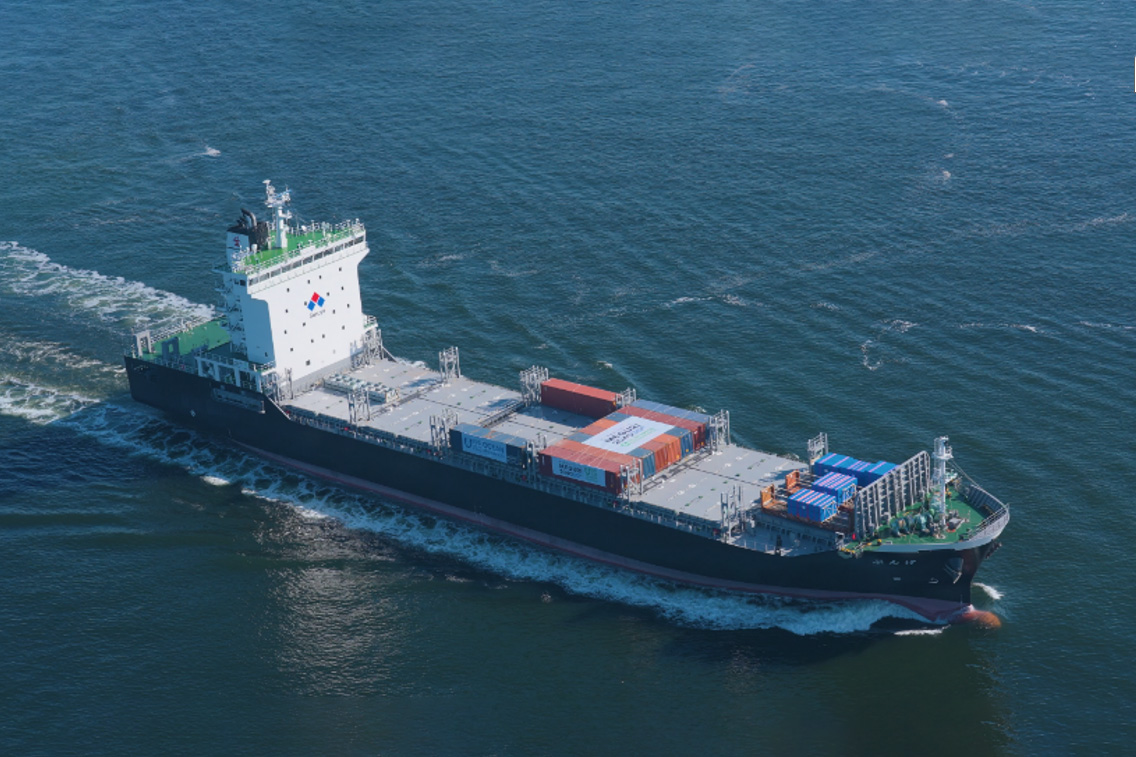
Coastal container ship GENBU
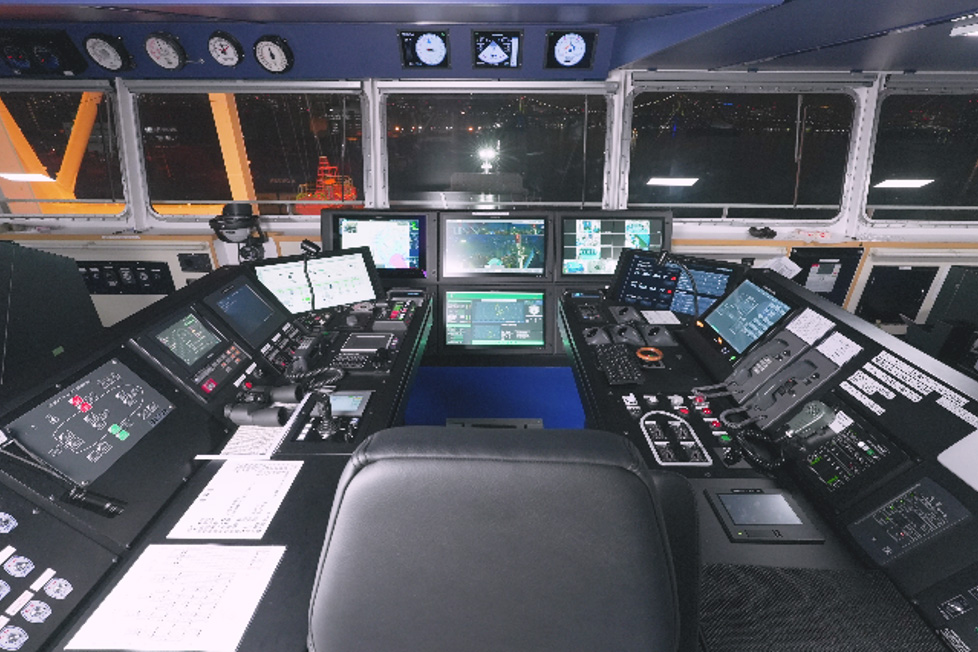
Bridge of GENBU
MTI’s Initiatives
In MEGURI2040, together with Japan Marine Science Inc. (an NYK-Group company) and Mitsubishi Research Institute, Inc. MTI acts as the PMO (Project Management Office) of the DFFAS+ Consortium (referred to as the “DFFAS” Consortium in Stage 1). We are vigorously leading and driving the development and practical implementation of autonomous ship technologies, focusing particularly on the concept design and risk assessment of autonomous ships targeting coastal ships.
As the project leader of the demonstration working group, MTI acted as the system integrator in collaboration with participating companies for the newly built container ship GENBU, which is equipped with a full suite of autonomous navigation functions equivalent to Level 4 autonomous navigation for automobiles. During the verification phase, we established the simulation platform for shore verification, coordinated land-based testing, and conducted verification at sea. As a result of these efforts, GENBU received the world’s first certification for autonomous ships from ClassNK and a certificate of inspection as an autonomous ship from MLIT, enabling autonomous operation in commercial service. We plan to address the evaluation and verification of post-operation safety and the reduction of crew workload going forward.
In addition to these initiatives for oceangoing ships, MTI is leading the standardization working group to help establish a common framework of essential technologies for autonomous ships and promote their market adoption.
To address social challenges in Japan’s coastal shipping – such as resolving labor shortages, reducing labor burdens, preventing maritime accidents, and maintaining offshore routes – and to support stable domestic logistics and transportation infrastructure, MTI will continue advancing MEGURI2040 in collaboration with The Nippon Foundation, DFFAS+ participating companies, and partner organizations inside and outside of Japan.
About the coastal container ship GENBU and demonstration testing / ship inspection
GENBU is a 134-meter-long, 700 TEU-class coastal container ship managed by IKOUS Corporation and operated by Suzuyo Marine Co., Ltd., engaged in container cargo transportation on a route from Kobe to Tokyo via Osaka, Nagoya, Shimizu, and Yokohama. While coastal shipping accounts for about 40% (by weight) of domestic cargo transportation and serves as critical infrastructure, the aging of seafarers and labor shortages have become serious challenges. From the perspective of improving the flow of logistics – the core objective of the project – the ship was designed and built as a flagship with all functions necessary for autonomous operations installed from the building stage, anticipating the future widespread adoption of autonomous ships.
In order for a ship to operate, it must pass a ship inspection to confirm compliance with technical standards established by the government. In June 2024, MLIT established a study group on autonomous ships to examine safety standards and inspection methods and published the results of its deliberations in June 2025. To operate as an “autonomous ship,” inspection is required to confirm that systems such as sensors, planners (which automatically plan collision-avoidance routes) and controllers function properly. On January 28, 2026, the ship passed the national ship inspection as an autonomous ship.
Going forward, the ship will continue autonomous navigation under commercial operation, and the operational data collected will be utilized for further domestic and international rulemaking related to autonomous ships.
In the maritime industry, classification societies serve as certification bodies that ensure ship safety and quality. Classification certification plays a particularly important role when obtaining insurance and financing. On this occasion, ClassNK, one of the world’s leading classification societies, established the world’s-first class notation “MASS” for autonomous ships, and GENBU became its first certified ship. This represents a significant step toward the practical implementation of autonomous ships.
Reference: “Outline of Inspection Methods for Autonomous Ships” (in Japanese)
*1 World’s first: According to research by The Nippon Foundation (as of January 2026), this represents the world’s first case of commencing “continuous practical commercial operation” at Level 4 equivalent autonomous navigation on a scheduled cargo route.
*2 Level 4 equivalent autonomous navigation: A technological stage in which fully autonomous navigation is partially possible under specific areas or conditions without human intervention. (Definitions of ship autonomous navigation are currently under discussion at the IMO and other bodies; for convenience, the automotive definition is applied.)
Reference: https://www.mlit.go.jp/common/001226541.pdf (in Japanese)
*3 MEGURI2040 Fully Autonomous Ship Program: Technological development grant program for the practical implementation of fully autonomous ships: A grant program supporting technological development to promote the practical implementation of fully autonomous ships, thereby fostering further momentum in this field and facilitating transformation of Japan’s logistics and socioeconomic infrastructure.The DFFAS+ Consortium, comprising 53 diverse Japanese companies, is engaged in technological development of fully autonomous ships.
Reference: https://www.nippon-foundation.or.jp/what/projects/meguri2040
Reference: https://www.jms-inc.jp/news/4371/ (in Japanese)
MTI promotes initiatives that contribute to achieving the Sustainable Development Goals (SDGs) through our business activities. Our efforts in digital technology utilization and technological development toward the realization of fully autonomous ships contribute to the achievement of the following goals.