
Binational agreement to collaborate on shipbuilding signed by University of Michigan and Japan’s MTI
ANN ARBOR, Mich. — September 16, 2026 — The University of Michigan’s (U-M) Department of Naval Architecture and Marine Engineering and MTI Co., Ltd., an NYK Group company based in Tokyo, today announced the signing of a Memorandum of Understanding (MOU) to formalize and expand their cooperation in maritime and shipbuilding research and education.
The agreement establishes a five-year framework to expand joint research projects, researcher exchanges and facilitate U.S.-Japan shipbuilding collaborations.
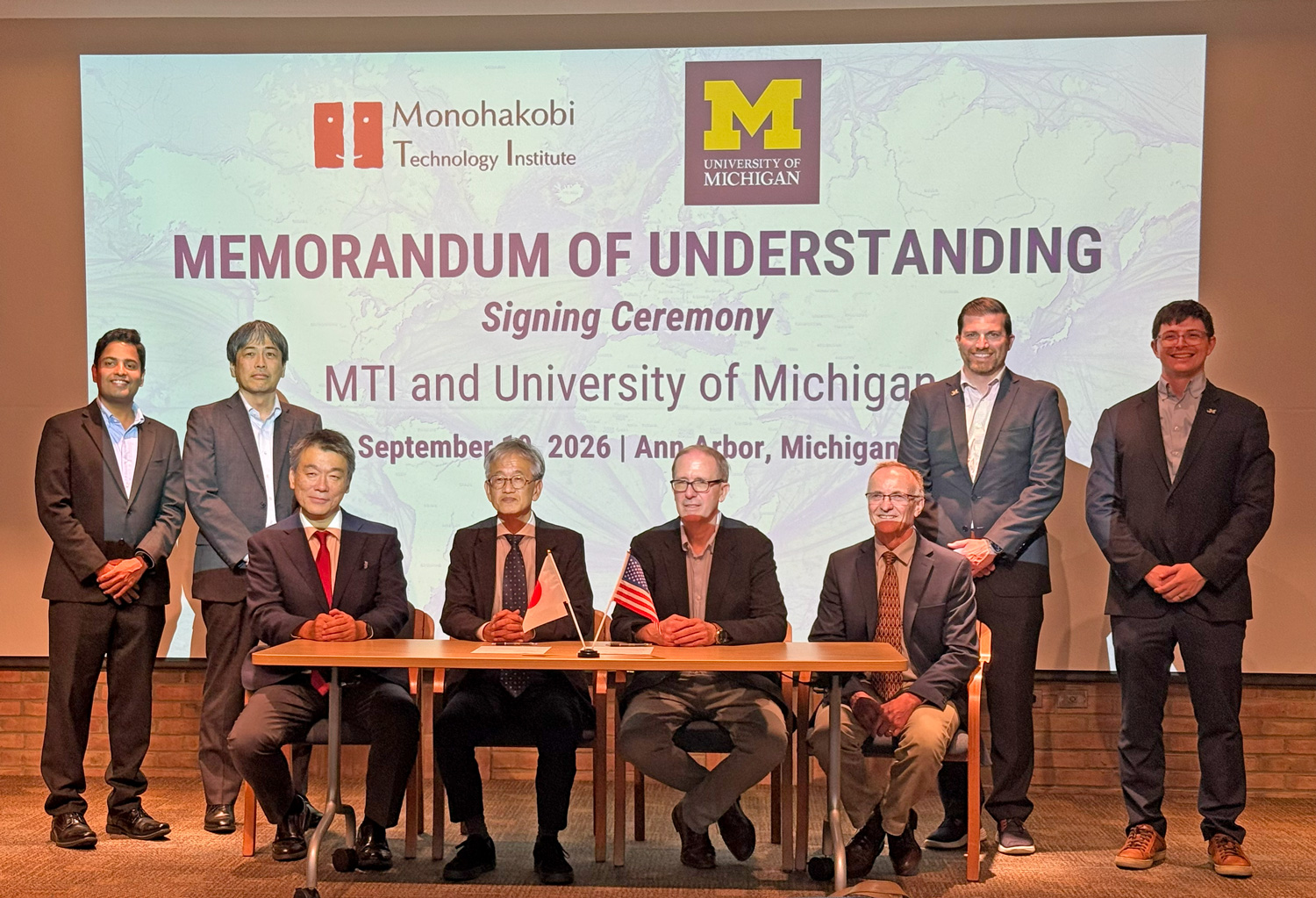
Representatives of the University of Michigan and MTI at the MOU signing ceremony. Seated in the front row (from left) are Hideyuki Ando, Managing Director, MTI; Hideki Suzuki, President, MTI; Todd Allen, Associate Dean for Research, University of Michigan Engineering; David Dowling, Chair of U-M’s Department of Naval Architecture and Marine Engineering. Standing in the back (from left) are Sreenath Subramaniam, Researcher, MTI; Yoshihiko Maeda, Deputy General Manager, MTI; Thomas McKenney, an associate professor of practice of naval architecture and marine engineering at U-M; and Alan Papalia, an assistant professor of naval architecture and marine engineering at U-M.
The MOU signing coincided with the “Deployment to Action” event, a two-day U.S.-Japan shipbuilding summit taking place September 9-10, 2026, at Newlab in Detroit and U-M. The event brought together U.S. and Japanese government officials, industry leaders, technology companies and researchers to explore pathways for re-industrializing and strengthening the maritime industries of both nations, with a technical focus on robotics, AI and advanced shipbuilding technologies. U-M and MTI presented their ongoing collaborative research at the event, ahead of the public release of the joint strategic framework and technology roadmap to be developed under the MOU.
Under the new agreement, the two institutions will jointly develop a comprehensive bi-national strategic framework, which identifies challenges and opportunities for shared research, development, testing and demonstration of advanced shipbuilding technology. The framework will also propose solutions that benefit both nations. The resulting framework and an associated technology roadmap will be released publicly as a joint product, intended to inform investment and funding decisions by maritime industries in both countries.
“Our current work has shown that when U.S. and Japanese researchers combine strengths in robotics and AI, we can see and understand shipyard operations in ways that neither country could achieve alone,” said Alan Papalia, an assistant professor of naval architecture and marine engineering at U-M. “This MOU gives us the structure to take that success and turn it into a shared strategic framework.”
“Shipbuilding revival in the United States and Japan will not come from copying old models, but requires us to see the whole system clearly enough to make good decisions together,” said David Singer, a professor of naval architecture and marine engineering at U-M. “This partnership with MTI lets us build that shared vision with one of Japan’s leading maritime technology organizations.”
“The strength of the U.S.-Japan shipbuilding relationship has always been mutually beneficial,” said Thomas McKenney, an associate professor of practice of naval architecture and marine engineering at U-M. “This MOU and the framework will give policymakers on both sides of the Pacific a clear, evidence-based roadmap for where joint investment can have the greatest impact.”
“MTI has long valued its collaboration with the University of Michigan, and this MOU reflects our shared commitment to strengthening the maritime industries of both our nations,” said Hideki Suzuki, President, MTI Co., Ltd. “We look forward to deepening this partnership and translating our research into real, actionable outcomes for shipbuilders in the U.S. and Japan.”
“Bringing together U.S. and Japanese perspectives on robotics, automation and AI in shipbuilding will help both countries identify where a joint effort has the greatest impact,” said Dr. Hideyuki Ando, MTI. “The framework we develop together will provide a practical blueprint for continued innovation and technology transfer between our nations.”
About the University of Michigan Department of Naval Architecture and Marine Engineering
With a legacy stretching back over 140 years, U-M is home to one of the nation’s first and few remaining departments dedicated to naval architecture and marine engineering. The department began with an 1879 act of Congress and has endured across generations as other U.S. institutions removed or downsized their naval architecture programs. Today, U-M continues to help shape Michigan and the nation’s maritime strategy, as well as serve as a global leader in shipbuilding and marine engineering education and workforce development.
Media Contact (U-M):
Derek Smith
Communications and Marketing
University of Michigan Engineering
Email: smitdere@umich.edu
+1-734-647-8630
About MTI Co., Ltd.
MTI Co., Ltd. is the research and development arm of the NYK Group, headquartered in Tokyo, Japan. MTI develops cutting-edge technologies in maritime digital transformation (DX), autonomous navigation, artificial intelligence (AI), robotics and environmental and energy systems, supporting the future evolution of safe, sustainable and efficient maritime transportation.
Media Contact (MTI):
Corporate Communications
Monohakobi Technology Institute (MTI)
Email: MTI.ML.PR@monohakobi.com