
Offshore Rocket Recovery
Background
The global space industry has expanded rapidly in recent years, creating growing demand for more frequent and cost-effective rocket launches. One solution being pursued worldwide is the development of reusable rockets, which are designed to be launched and recovered multiple times. For Japan, a maritime nation with limited land area, the ability to recover reusable rockets at sea rather than on land is essential to ensuring their safe and efficient operation. Offshore recovery is therefore regarded as a highly important area within Japan’s national space technology strategy. As a member of the NYK Group, MTI will contribute to the development of this new form of social infrastructure by applying its long-standing research and development expertise and autonomous ship navigation technologies.
Objectives
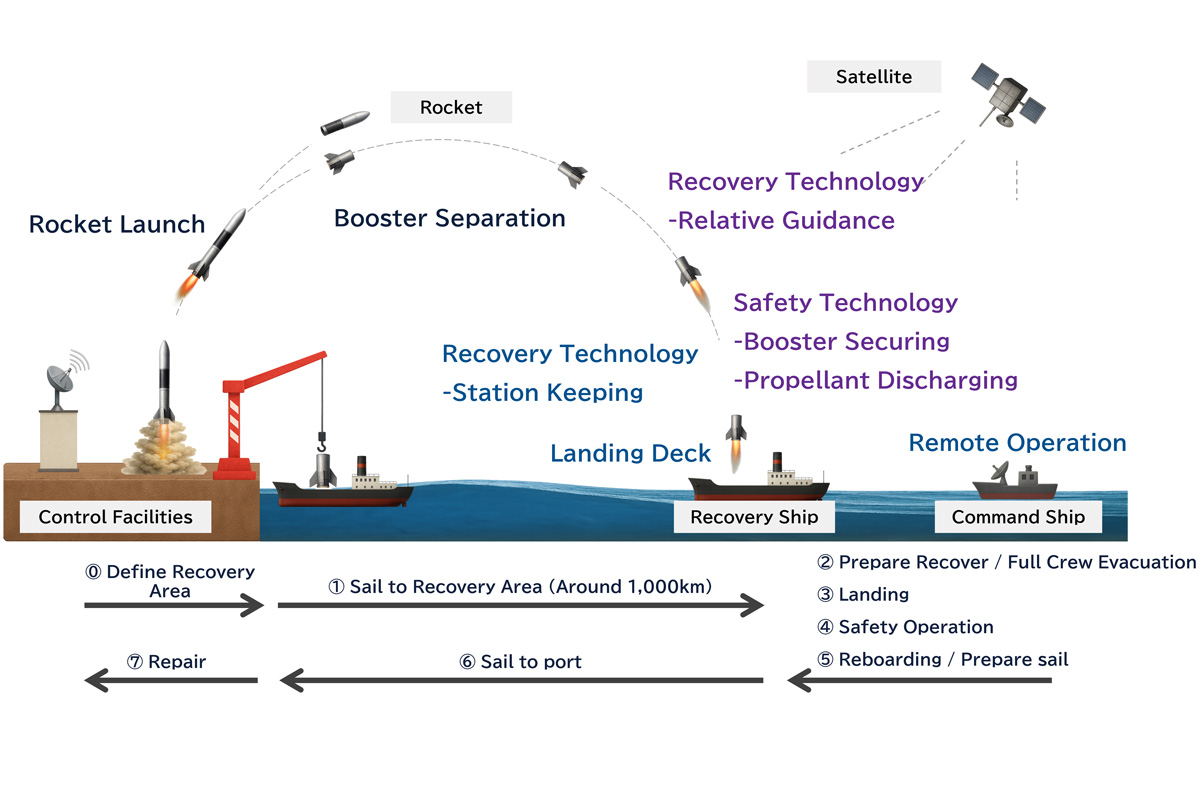
The project aims to develop and demonstrate an integrated system that enables a reusable rocket to land on an offshore recovery vessel and be returned safely. The project will focus on the following areas:
- Development of an Offshore Recovery System for Open-Sea Operations
- Rocket capture technology: Technology designed to ensure the reliable landing of a rocket by utilizing offshore station-keeping capabilities, including dynamic positioning systems (DPS).
- Safety technologies: Technologies for securing the recovered rocket on board the vessel and safely discharging and handling any residual propellant.
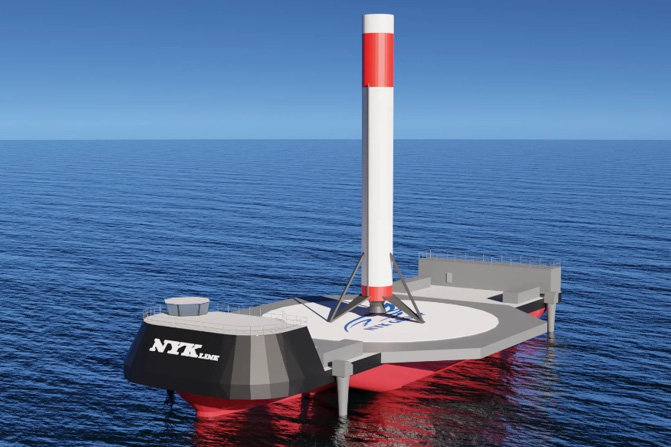
- Landing deck development: Development of a specialized deck structure capable of withstanding the high-temperature exhaust plume and impact loads generated during rocket landing.
- Remote operation technology: Technology for remotely controlling and monitoring the rocket recovery vessel from a command environment or other remote location. The recovery vessel will operate without personnel on board during the rocket landing.
- Demonstration Testing and Safety Assessment
- Construction of a prototype offshore recovery vessel and implementation of land-based and offshore demonstration tests, scheduled for FY2028.
- Development of guidelines based on operational plans, maintenance plans, and equipment requirements, as well as the acquisition of Approval in Principle (AiP).
Conceptual System Configuration
The offshore recovery system is envisioned as a two-vessel configuration comprising a recovery vessel, on which the rocket’s first stage will land, and a command vessel, which will support and coordinate the recovery process. The recovery vessel will be completely unmanned during the rocket landing. Once the vessel and recovered rocket have been confirmed safe, the recovery vessel will coordinate with the command vessel and return to port.
Partners

Related Links
-
- Overview of the Space Strategy Fund (SSF) by Space Strategy Fund Department Japan Aerospace Exploration Agency (JAXA)
- Press release of NYK on April 22, 2025: “NYK Selected for JAXA’s Space Strategy Fund”
- Press release of NYK on July 24, 2025: “NYK Obtains Approval in Principle for Offshore Reusable Rocket Recovery System” 」
This initiative is supported by funding from the Space Strategy Fund.